This article, how to prepare inductive sermons, provides some tips for writing inductive sermons. The inductive sermons paradigm is generally used to organise biblical narratives for preaching.

How to Prepare Inductive Sermons?
When you prepare sermons, you usually prepare them deductively, inductively or a bit of both.
Generally speaking, deductive sermons begin with the main preaching point followed by sub-points and incidental points; whereas, inductive sermons begin with the incidental points moving towards the main preaching point. In other words, in a deductive sermon, the main preaching point is at the beginning of a sermon; whereas, in an inductive sermon, the main preaching point is at the end of the sermon.
The Model for an Inductive Sermon
There are different ways to structure an inductive sermon. However, Lowry’s Loop seems to work perfectly for preaching narratives from the Scriptures.
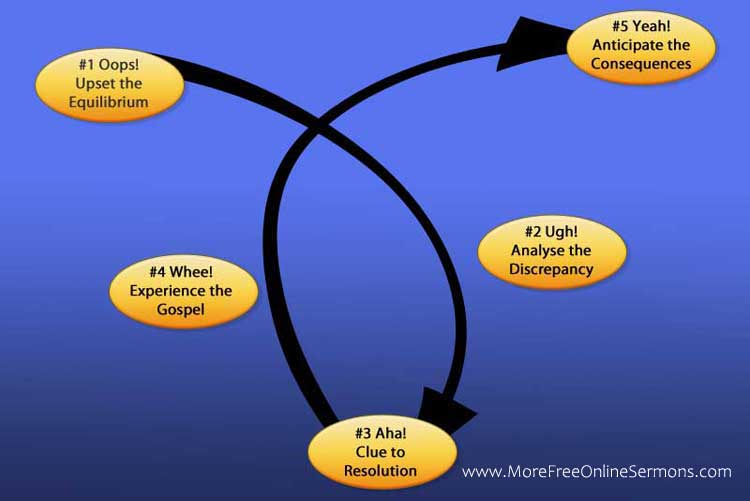
The layout of Lowry’s Loop has five stages.
- OOPS – Upsetting the Equilibrium (Introducing the tension)
- UGH – Analysing The Discrepancy (Understanding the tension)
- AHA – Disclosing the Clue to Resolution (Solving the tension)
- WHEE – Experiencing the Gospel (Serenity – The tension is gone)
- YEAH – Anticipating the Consequences (Tension avoided)
The climax of the inductive sermon is the AHA and WHEE stages.
Preparing Inductive Sermons
There is a narrative in Mark 14:66-72 where Peter made great boasts about his relationship with Jesus, but when it was put to the test, he completely and utterly disowned Jesus.
The main preaching point of this narrative is that biblical faith is grounded in humility that leads to repentance not self-confidence that leads to superficial boasting.
Using Lowry’s Loop inductive paradigm to outline this narrative.
- It’s tough being a man of your word
- Peter found it tough being a man of his word (Mark 14:66-71)
- Peter’s words were not grounded in faith but self-confidence
- Bible faith is grounded in humility that lead to repentance (Mark 14:72)
- When we see faith from this prospective, we will stand strong and be a witness for God
Notice in point 1 that the tension is introduced, in point 2 the tension is explained, in point 3 and 4 the tension is resolved and in point 5 the tension is avoided because we now see faith from the right prospective.
Writing Inductive Sermons
When you are writing an inductive sermon, you must keep in mind that a sermon has three parts: an introduction, the body and the conclusion. The introduction introduces the tension, the body explains and resolves the tension and the conclusion states how to avoid the tension.
Let’s write an inductive sermon from Mark 4:66-72 using the inductive outline above.
1. It’s tough to be a man (or a woman) of your word
Associated Press reporter Terry Anderson was held hostage in Lebanon for nearly seven years. He was chained to a wall in a filthy, spider-infested cell. He suffered through sickness. He endured mental torture. He longed for his family. He was ground down by the dull ache of incessant boredom.
Through it all, he was given one book—the Bible—and he devoured it in search of words of hope. It was the Word of God that strengthened him to endure his captivity.
After 2,455 mind-numbing days of cruel captivity, Andersen was finally released on December 4, 1991. Journalists clustered around and peppered him with questions. They wanted to know what his ordeal had been like. They wanted to know his plans for the future.
But then one reporter called out a question that stopped Andersen in his tracks: “Can you forgive your captors?” You know, that question reverberated in his mind. “Can you forgive your captors?” You see, Andersen was a Christian and he believed in the Word of God with all his heart. God’s words were his words. He had spent so much time in God’s word that they became his words.
Andersen paused, and before the words of his response could come out of his mouth, the Lord’s prayer coursed through his mind. He had prayed the Lord’s prayer so many times that it had become his prayer…his words: “Forgive us our sins, for we also forgive everyone who sins against us.”
You know, it’s tough to be a man of your word.
2. Peter found it tough to be a man of his word (Mark 14:66-72a)
When Jesus faced His final hour of testing, he said to the disciples, “All of you will be made to stumble because of Me this night, for it is written: I will strike the Shepherd, And the sheep will be scattered.”
Now, Peter was horrified at this thought. To think that he would stumble, especially when he had already confirmed that Jesus was the Christ (Mark 8:29). This utterly horrified him.
So Peter declared to Jesus, “Even if all are made to stumble, I will not.” And Jesus said to Peter, “Assuredly, I say to you that today, even this night, before the rooster crows twice, you will deny Me three times.”
Peter became indignant, and “spoke more vehemently, ‘If I have to die with You, I will not deny You!’”
Peter’s words convey that he would never be disloyal to Jesus…that he would never deny his Lord.
Well, Peter’s words were put to the test that night in the high priest’s courtyard.
This man who sprouted that he would rather die than deny Jesus, had now completely and utterly disown Him. And what made it so hypocritical and hideous was that he called God as a witness to this lie.
What made Peter in one breath make great boasts about his stance for Christ, and yet in another breath deny Him completely and utterly? What happen to this man who declared Jesus as the Christ?
In many ways, we’ve seen this happen before. We may have even done it ourselves to our shame. We’ve seen people make great boasts about their stance for Jesus, but in practice they have denied Him. We too may have made great boasts about our stance for Jesus, but in practice we have denied Him.
Yes, it may be tough to be a man (or a woman) of your word. But there is more to it than that.
3. You see, Peter’s words were not grounded in faith but self-confidence
A. Peter’s confidence in self led to boasting
It was Peter’s confidence in self that said, “If I have to die with You, I will not deny You!”
B. Peter’s confidence in self led to pride
Look at me, I’m not like the other disciples. They may fall away (or stumble), but I will never fall away.
C. Peter’s confidence in self led to blindness
Self got in the way of Peter seeing what Jesus was trying to tell him.
D. Peter’s confidence in self led to independence
How many times did Peter take things into his own hands? Lord, you’ve got it all wrong. Remember, he was talking to the King of Kings and Lord of Lords. Instead of accepting what Jesus said, Peter disputed with Jesus and done things his way.
Man, do we see that today.
Peter’s words were not grounded in faith but in self-confidence.
4. Instead, biblical faith is grounded in humility (Mark 14:72)
God had to humble Peter in a way that would change his life forever.
Look at verse 72, “And a second time the rooster crowed. And Peter called to mind the word that Jesus had said to him, “Before the rooster crows twice, you will deny Me three times. And when he though about it, he wept.”
Luke 22:61 says, “And the Lord turned to look at Peter. And Peter remembered the word of the Lord, how He had said to him, ‘Before the rooster crows, you will deny Me three times.’ Then Peter went out and wept bitterly.”
In that moment of humility, Peter is broken. He sees himself as he really is…a sinful man in need of God’s mercy and forgiveness.It was in this moment of humility, Peter shed tears of repentance as he wept bitterly in light of his denial of Jesus (his sin).
Faith grounded in humility leads to tears of repentance—seeing ourselves as we really are.
Faith grounded in humility leads to confidence in God and his word not in self (no longer disputing God’s word but accepting it and obeying it).
5. When we see faith from this perspective, our lives will change and we will stand firm for Jesus regardless
When Peter saw faith from this perspective, his life changed dramatically. Moreover, he became a great preacher of the gospel of Jesus Christ. In fact, when he was told by the religious leaders not to speak or teach in the name of Jesus, he said, “For we cannot but speak the things which we have seen and heard.”
What an impact this man’s faith has had on the church of Jesus Christ!
When Terry Andersen saw faith from this perspective, he was able to say to that reporter: “Yes, I can forgive my captors.” Why? Because his faith was grounded in humility that lead to brokenness, repentance and confidence in God and His word
More Resource Material
How To Write Deductive Sermons (The Model For Writing Deductive Sermons).
How To Prepare Inductive Sermons (The different models for preparing inductive message).
How To Write Inductive Sermons (The different model for writing inductive sermons).